

Product details
Key Features of an Analog Voltmeter:
- Measurement of Voltage:
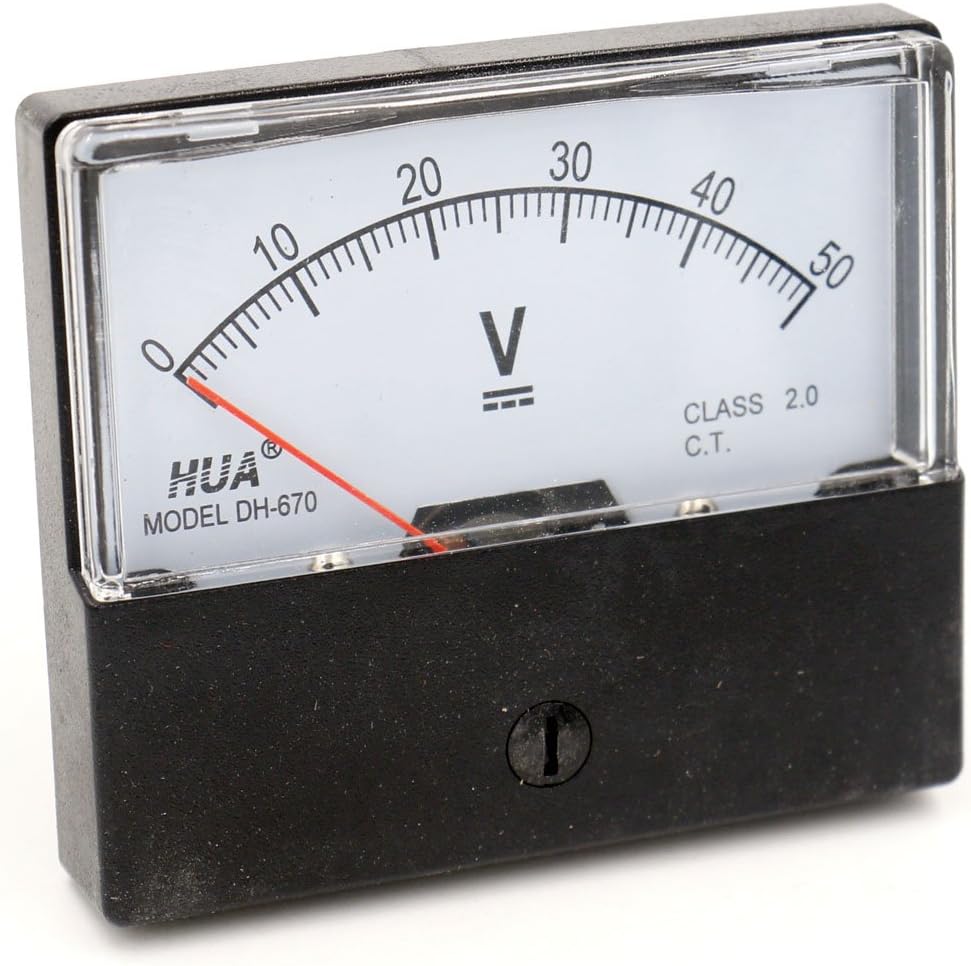
- An analog voltmeter is designed to measure DC (Direct Current) or AC (Alternating Current) voltages depending on its specific design. The voltage is shown as a needle that moves across a graduated scale, where each position corresponds to a specific voltage value.
- Needle and Scale:
- The voltmeter has a needle that moves along a scale. The position of the needle indicates the measured voltage. The scale is usually marked with graduations that represent the voltage readings (e.g., 0V, 5V, 10V, etc.).
- Analog Display:
- The display is analog because it is continuous, rather than discrete like a digital readout. This means the voltage measurement can be observed as a smooth movement of the needle, which provides a more real-time response compared to digital versions.
- Sensitivity:
- Analog voltmeters come with different ranges or scales, such as 0-10V, 0-100V, or 0-1000V. The sensitivity or accuracy of the reading depends on the resolution of the scale and the range of the voltmeter.
- Internal Circuitry:
- Most analog voltmeters use a moving coil meter principle, where the needle moves in response to the current flowing through a coil placed in a magnetic field. The deflection of the needle is proportional to the voltage being measured.





There are no reviews yet.